

Four Hormones, One Strip: Does Inito’s Data Match Its Reviews?
Inito tracks four fertility hormones from one test strip, more than any competitor. But there's a real gap between its own rating and what independent reviewers say, comparing it to Mira, Clearblue, Premom, and Proov.
➤ Read the review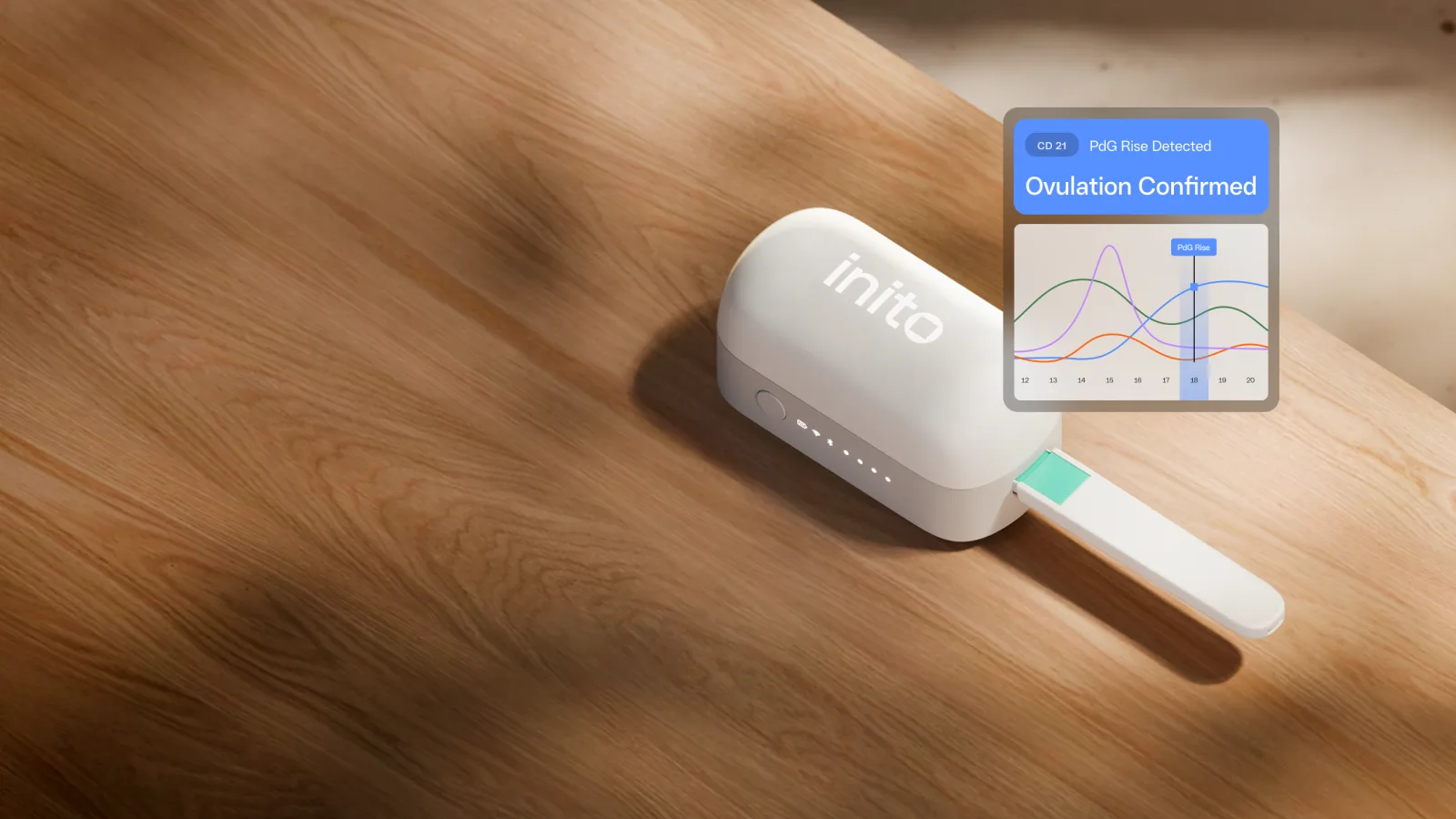
The verdict at a glance
Inito tracks more hormones than any at-home competitor we found, that part is genuinely differentiated. But the regulatory story and the review data are messier than the marketing page suggests, and that’s worth knowing before you spend $119 or more on a starter kit.
Tracks estrogen (E3G), LH, PdG, and FSH on one strip, broader than any competitor reviewed here.
Described only as “Class I, 510(k)-exempt” in press coverage, we couldn’t independently confirm this in FDA’s own database.
$119-169 starter kit, $49 per 15-strip refill, about $3.27 a strip: mid-range for a multi-hormone monitor.
Trustpilot 2.9/5 (20 reviews), BBB “D” rating, both far below the brand’s own 4.3 star claim.
Who is Inito?
Inito was founded in 2015 by Aayush Rai and Varun Akur Venkatesan, two former Siemens medtech engineers who met kayaking and left their corporate jobs to build an at-home hormone-tracking tool. The company has raised roughly $15 million, including a $6M Series A in 2023 led by Fireside Ventures, with early backers including Y Combinator and former Nurx CEO Varsha Rao.
The device is a reusable smartphone-connected reader (the InSight) paired with disposable urine test strips. Its proprietary Spectral Mapping technology combines fluorescence and colorimetric imaging to read the strip continuously rather than at a single moment, which is how it extracts four hormone readings, estrogen (E3G), LH, PdG, and FSH, from one strip. That’s more hormones than any other product in this comparison. You can shop the brand directly at inito.com.
Product spotlight: the Inito Fertility Monitor
The starter kit runs $119 to $169 for the reader and 15 strips, with refills at $49 per 15-strip pack, about $3.27 a strip. It’s sold direct-to-consumer only (inito.com, Amazon), with no retail or pharmacy presence we could find. Its regulatory status is reported as Class I, FDA 510(k)-exempt, per press coverage, though we could not independently confirm this classification in FDA’s own database. Note on pricing: Inito’s list and promo prices move around, we saw $169 listed with a $119 promo, and a 2023 press citation of $149 for the same bundle. Treat any single number as a snapshot, not a fixed price.
What the accuracy study actually says
Inito’s blog cites roughly 95% accuracy matching urinary hormone patterns to blood hormone trends. That traces back to a real, peer-reviewed study published in Human Reproduction Open (Oxford Academic) in 2023, testing a total of 40 participants (20 in an experimental cohort, 20 in a verification cohort, 73 data points total), with reported correlations between urinary and serum hormones ranging from r-squared 0.92 to 0.98 depending on the hormone and cohort.
A real, if modest, piece of evidence, not independent third-party validation.
⚠️ A conflict of interest worth naming plainly
- All four authors of the study are Inito co-founders or staff at Inito’s contract research partner. It’s a legitimate, peer-reviewed journal, but brand-authored research on a small sample, not independent validation.
- A separate, earlier 2022 preprint by the same authors (140 more participants) explicitly states it “has not been certified by peer review.”
- Inito’s marketing also states it is the “most precise” monitor based on head-to-head lab testing against competitors, that comparison is brand-funded and self-reported, not published.
None of this means Inito doesn’t work reasonably well, a 40-person correlation study with strong correlations is a real, if modest, piece of evidence. It means the accuracy headline number deserves the same scrutiny you’d give any single-company-funded study: promising, not independently confirmed.
Comparison: Inito vs. Mira, Clearblue, Premom & Proov
We picked the four most relevant alternatives: Mira, the closest direct multi-hormone rival; Clearblue, the legacy category leader sold at every major pharmacy; the Premom / Easy@Home combo, the budget high-frequency-testing option; and Proov, the only brand here with a clearly documented FDA clearance.
| Brand / Product | Price | Hormones tracked | FDA status | Independent reviews |
|---|---|---|---|---|
| Inito Fertility Monitor |
$119-169 kit + $49/15 strips | E3G, LH, PdG, FSH (4) | Class I, reported 510(k)-exempt (unconfirmed) | Trustpilot 2.9/5 (20); BBB “D” |
| Mira Fertility Max Kit |
$219-229 | LH, E3G, PdG (3, tiered) | PdG “Confirm Wand” FDA cleared (2021) | Brand-hosted only (4.5-4.8/5) |
| Clearblue Advanced Fertility Monitor |
~$130 + ~$38/30 sticks | Estrogen, LH (2) | Not stated on product page | 4.6/5, 1,200-1,500 ratings (Walmart) |
| Premom / Easy@Home LH strips (+ PdG combo) |
$9.99-$35.99 | LH (primary); PdG with combo kit | Registered in FDA’s GUDID; clearance number not located | Brand-hosted only (4.78-5.0/5) |
| Proov Confirm (PdG strips) |
$21.66-$29.99 / cycle | PdG only (confirms, doesn’t predict) | Verified FDA 510(k) clearance (2020) | Not found |
🔒 A real privacy caveat worth knowing about this category
- In May 2023, the FTC settled with Easy Healthcare Corp. (Premom’s maker) over sharing users’ reproductive health data, including ovulation and pregnancy status, with third parties without consent, and for violating the Health Breach Notification Rule.
- The company paid $200,000 combined in penalties and was permanently banned from sharing health data for advertising.
- This isn’t a knock on Premom’s test accuracy, but it’s a legitimate reason to read the privacy policy of any fertility-tracking app carefully, this category handles some of the most sensitive data people share with any app.
Positioning radar: Inito vs. Mira
Positioning (editorial scoring out of 10, for illustrative purposes)
Inito Mira (dashed). Inito leads on hormone breadth; Mira leads on documented FDA clearance for its PdG wand. Neither brand publishes a fully independent, high-volume review dataset.
Who should choose what?
The gap between Inito’s rating and independent reviews
This is the section we think matters most for anyone about to spend $119 or more on a starter kit. Inito’s own sales page states 4.3 stars from over 1,600 reviews, not independently audited. Trustpilot shows 2.9/5 across 20 reviews, rated “Average,” with a bimodal distribution (35% five-star, 50% one-star). The Better Business Bureau gives it a “D” rating, with 11 complaints on file, including one unanswered. Its companion app, on the Apple App Store, holds 4.9/5 across roughly 4,600 ratings, though that rates the app’s usability, not the device’s accuracy.
We want to be fair here: 20 Trustpilot reviews is a small sample, and app store ratings suggest people who use Inito’s app day-to-day generally like it. But a “D” BBB rating with real, documented complaints isn’t a small-sample problem, it’s a pattern worth knowing about before you buy, and it’s exactly the kind of thing a brand’s own marketing page will never show you.
FAQ
Is Inito FDA-approved?
No product in this category is FDA-approved the way a drug is. Inito is reported as a Class I device exempt from FDA premarket review, which means no FDA review occurred before it went to market, a different, lower bar than the clearance Proov and Mira’s PdG wand have documented.
Can Inito replace a fertility clinic workup?
No. At-home hormone monitors, Inito included, are consumer wellness tools for cycle tracking, not a substitute for a clinical fertility evaluation from a reproductive endocrinologist if you’re facing fertility challenges.
Why is there such a big difference between Inito’s rating and Trustpilot’s?
We can’t say for certain, it could reflect a small, unrepresentative Trustpilot sample, a self-selection effect on which reviews land where, or genuine dissatisfaction among a subset of customers reflected in the BBB complaints. What we can say is that the gap is large enough to be worth knowing about rather than only seeing the brand’s preferred number.
Our final verdict
Inito’s four-hormone approach is a genuine differentiator, and the accuracy study behind it, while small and brand-authored, is real, peer-reviewed science, more than some competitors can show. But this is a purchase where the fine print matters: an unconfirmed FDA classification, a 2.9 star independent rating, and a “D” BBB grade aren’t disqualifying on their own, but together they’re reason enough to go in with tempered expectations rather than the brand’s own 4.3 star pitch.
If documented FDA clearance matters most to you, Proov or Mira’s PdG wand have the clearer paper trail. If you want the single most hormone-rich picture of your cycle and are comfortable with a newer company’s rougher edges, Inito remains the most complete option on the market today, in line with the 3.0/5 we’re giving it here.
Want to compare kits side by side?
Check current pricing directly from each brand before you buy.